TIMBERTECH DECK REPLACEMENT IN CENTENNIAL, CO
If your Centennial home was built in the 1980s and still has its original deck, that structure is somewhere between 35 and 45 years old. It was probably built from pressure-treated pine or redwood, fastened with materials that have since been recognized as inadequate, and attached to your house in a way that current code no longer permits.
The boards are the part you look at. They’re rarely the part that matters.
5280 Exteriors builds TimberTech composite and PVC decks throughout Centennial, and we hold a NADRA deck evaluation certification. This guide covers what actually fails on an aging Colorado deck, what a replacement involves structurally, and what the project costs.
The Part That Fails First Is the Part You Can’t See
When homeowners call us about a deck, they describe the surface: boards that have gone gray, splinters, a soft spot near the stairs, a railing that wobbles.
Those are symptoms. The structural story is underneath.
The ledger board. This is the horizontal member that attaches the deck to your house. It carries roughly half the deck’s total load, and it’s the single most common point of catastrophic deck failure nationally. Decks built in the 1980s were frequently attached with nails rather than structural bolts or approved screws, and often without proper flashing where the ledger meets the house.
No flashing means water runs behind the ledger and into your rim joist every time it rains or snow melts off the deck. That happens for thirty-five years. By the time anyone looks, the framing the deck is bolted to has been quietly rotting for decades, and so has the wall behind it.
This is why we don’t resurface old decks. Putting beautiful new composite boards on compromised framing is putting a new roof on a house with a cracked foundation — it looks finished and solves nothing.
Other things we find routinely on Centennial teardowns:
- Footings poured too shallow, above frost depth, so the posts have heaved and settled through decades of freeze-thaw cycles
- Galvanized fasteners corroded by contact with modern pressure-treated lumber chemistry
- Joist spacing that was adequate for the era’s wood decking but is too wide for composite, which requires closer support
- Guardrails below current height requirements, and baluster spacing wide enough to fail today’s inspection
- Stair rise and run that’s inconsistent step to step, which is both a code issue and how people fall
None of this means anyone did anything wrong in 1985. Standards moved. But it does mean a replacement is a structural project, not a surface project.
Why Composite Rather Than Wood Again
Colorado is genuinely hard on wood decks. Our sun is intense at 5,800 feet, our humidity is low, and our freeze-thaw cycling is aggressive. Wood on a Centennial deck goes through wet-dry and freeze-thaw swings constantly, and it responds by cupping, checking, splitting, and splintering.
The maintenance answer is sanding and resealing every two to three years. Most people do it once or twice and then stop, and the deck deteriorates from there.
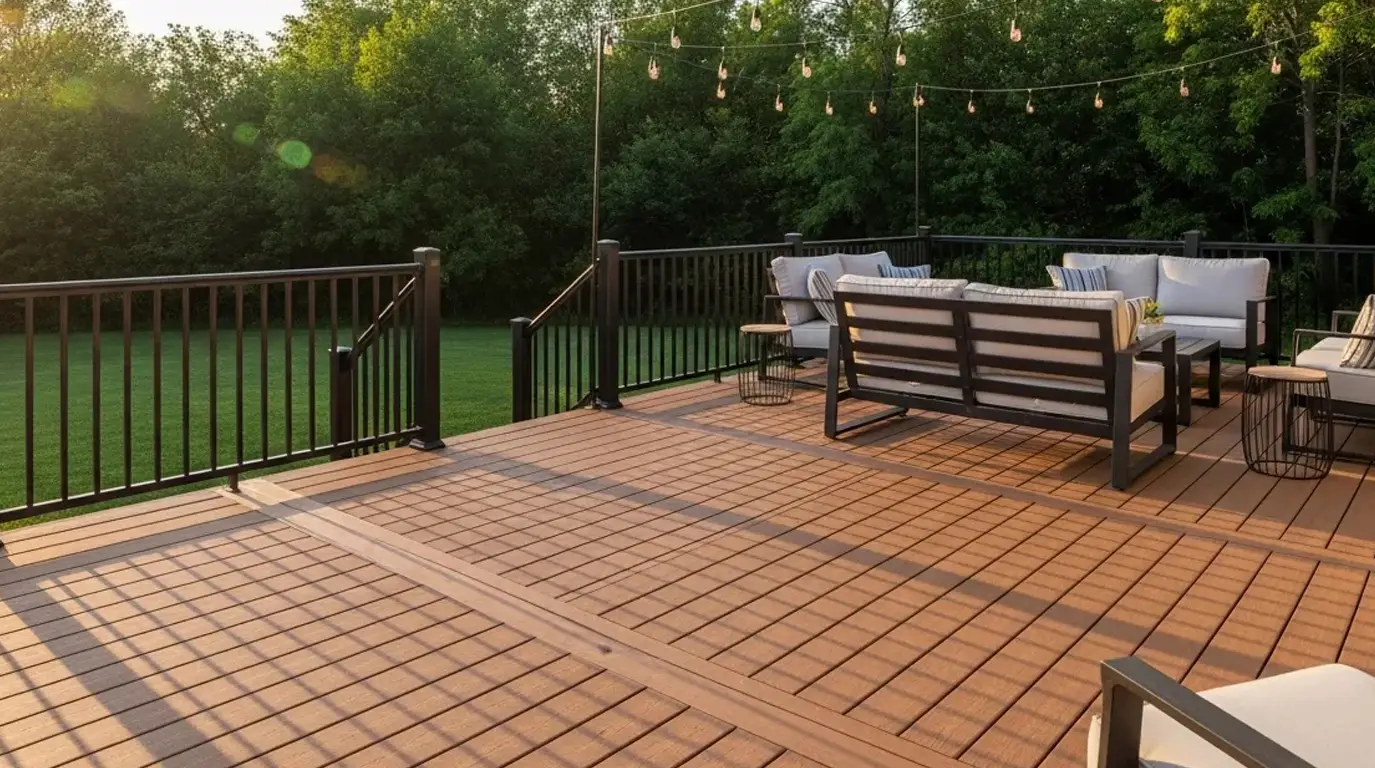
TimberTech composite and PVC decking eliminates that cycle. It doesn’t need sanding, staining, or sealing. It doesn’t splinter. It doesn’t rot. It holds its color in UV exposure far better than stained wood, and it doesn’t get slippery when wet the way an aging sealed wood surface does.
One honest tradeoff worth knowing: dark composite decking gets hot in direct sun. On a south or west-facing Centennial yard with no mature tree canopy — which describes a lot of homes in the newer parts of the city — lighter colors are meaningfully more comfortable underfoot in July. We’ll steer you there if your exposure warrants it. It’s the kind of thing that’s easy to fix at selection and impossible to fix later.
TimberTech Lines We Install
|
COLLECTION
|
MATERIAL
|
CHARACTER
|
|---|---|---|
|
Prime+
|
Capped composite
|
Entry point into the line. Solid performance and color retention at the most accessible price.
|
|
Terraine+
|
Capped composite
|
Warmer, more varied grain pattern. A good middle ground on budget and appearance.
|
|
Reserve
|
Capped composite
|
The most convincing wood-grain visual in the composite range, with distinct color variation board to board.
|
|
Landmark
|
Capped PVC
|
Top tier. PVC rather than composite — lighter, the most stain and fade resistant, and the coolest underfoot of the group.
|
We also install aluminum framing systems as an alternative to wood substructure. It costs more up front, but it doesn’t rot, doesn’t warp, and outlives the decking on top of it. Worth discussing if you intend this to be the last deck you build.
Railings, stairs, lighting, and hidden fastener systems are all part of the conversation. Integrated riser and post-cap lighting is a small line item that makes a disproportionate difference on a deck people actually use after dark.
Building It Right for Colorado
Footings below frost depth. This is not optional and it’s the most common shortcut in deck construction. If footings don’t extend below the frost line, the ground freezes underneath them, expands, and lifts the posts. Over enough winters the deck racks out of level and the connections loosen. Getting this right is why a properly built deck stays flat for decades.
Ledger attachment and flashing. New structural fasteners, correct spacing, and flashing that directs water away from the house rather than into it. If we find rot in the rim joist during teardown — and on 1980s decks we frequently do — that gets repaired before anything gets attached to it.
Joist spacing for composite. Composite requires tighter joist spacing than dimensional wood decking, and closer still for diagonal board patterns. Reusing old framing built for wood is a common way to end up with a deck that feels bouncy.
Code-compliant railings and stairs. Guardrail height, baluster spacing, graspable handrails, and consistent stair geometry. These are inspection items, and more importantly they’re the parts of a deck that hurt people when they’re wrong.
Permits and Inspection
Deck replacement in Centennial requires a permit, and structural work gets inspected. We pull permits, submit plans, and coordinate inspections as part of the project.
Two things worth knowing:
If your deck is above a certain height or serves a second-story door, the structural requirements and inspection scope increase. And if your home is in an HOA — which most of Centennial is — expect an architectural review for the deck as well, particularly for railing style and color. We’ll help assemble the submission.
What a Deck Replacement Costs in Centennial
Deck pricing depends more on structure than on surface, which surprises people.
What drives the number:
- Square footage and height off the ground. A second-story deck costs substantially more than a ground-level one — taller posts, larger footings, more bracing, more difficult work.
- Substructure condition. If the framing is sound and correctly spaced, some of it may be reusable. On most 1980s decks, it isn’t.
- Decking line. Prime+ to Landmark PVC is a real range.
- Railing system. Composite, aluminum, and cable railing differ significantly in cost.
- Stairs. Stairs are labor-dense. A deck with two stair runs costs meaningfully more than one with a single run.
- Aluminum vs. wood framing. Higher up front, longer life.
- Lighting and built-ins. Benches, planters, pergolas, and integrated lighting all add scope.
We give you an itemized estimate rather than a lump sum, so you can see where the money goes and make deliberate tradeoffs — for example, choosing a higher-end decking line while keeping the railing simple.
On the value question: composite costs more than wood at installation and less over the life of the deck, because there’s no recurring sanding, sealing, and board replacement. If you’re planning to be in the house another ten years, the arithmetic generally favors composite. If you’re selling in eighteen months, that’s a different calculation and we’ll say so.
Doing the Deck With Siding
A meaningful share of our Centennial projects combine deck replacement with siding.
There’s a practical reason. The ledger board connects the deck to your house through the siding. If you replace siding later, that connection has to be worked around. If you replace the deck later, the same. Doing both at once means the wall behind the ledger gets opened, inspected, flashed, and closed as a single detail — which is exactly where water problems start when it’s done in two passes.
It also means one permit process, one crew mobilization, one warranty, and one disruption to your summer instead of two.
Why 5280 Exteriors
NADRA deck evaluation certified. The North American Deck and Railing Association certification covers structural inspection and code compliance — the underneath part of the deck rather than the visible part.
Headquartered in Centennial on South Yosemite Street. These are our neighborhoods.
We build the whole exterior. Siding, windows, roofing, and decking under one contractor.
James Hardie Elite Preferred Contractor and back-to-back Presidents Club Award winner (2024–2025).
10-year workmanship warranty on top of TimberTech’s product warranty.
Learn more about your complete Centennial exterior options:
- Siding Contractors in Centennial, CO — James Hardie fiber cement specialists
- Pella Window Replacement for Centennial — Authorized Pella dealer and installer
- Complete Centennial Exterior Services — Full system overview
Centennial Decking Questions
Can I just replace the boards and keep the frame?
Sometimes, but rarely on a deck from the 1980s. Composite requires tighter joist spacing than the wood decking most old frames were built for, and the ledger attachment and footings usually don’t meet current standards. We evaluate the substructure before recommending anything — if the frame is genuinely sound, we’ll tell you, because that’s a much cheaper project.
How long does composite decking last?
Well past the wood it replaced. TimberTech backs its collections with substantial limited warranties that vary by line, and the practical service life in this climate is decades rather than years. The bigger variable is the framing underneath, which is why we don’t cut corners there.
Does composite decking get hot?
Darker colors do, in direct sun, like any dark surface. If your yard faces south or west without shade, choose a lighter color. It makes a real difference in July and it costs nothing to decide correctly at selection.
How does composite handle hail?
Better than most people expect. Capped composite and PVC resist the denting and cracking that hail causes on some surfaces. Severe hail can mark any material, but decking sits horizontally and takes impact differently than a vertical wall.
Do I need a permit for a deck in Centennial?
Yes, for replacement or new construction. Structural work is inspected. We handle permitting and inspection coordination.
When’s the best time of year to build?
We build year-round. Spring books up fastest because everyone wants the deck ready for summer, which means spring projects need to be scheduled in winter. Fall is often the easiest time to get on the calendar, and the weather cooperates well for construction.
What about my old deck — do you haul it away?
Yes. Demolition and disposal are part of the project scope, not a separate line you arrange yourself.
Get a Free Centennial Deck Estimate
If your deck is graying, splintering, wobbling at the rail, or just old enough that you’ve stopped using it, we’ll come look at the structure and tell you honestly what you’ve got. Sometimes the answer is that the frame is fine and this is a smaller project than you feared. More often it isn’t — but you’ll know either way before you spend anything.
Call (720) 707-6964 or request a free estimate.
Serving Centennial, Southglenn, Willow Creek, Cherry Knolls, Foxridge, Homestead, Piney Creek, Smoky Hill, Walnut Hills, and Heritage Greens.
Explore our full range of exterior services in Centennial.