Jefferson County’s Wildfire Resiliency Code and Your Deck
Jefferson County’s Wildfire Resiliency Code officially took effect on July 1, 2026. It applies to properties across unincorporated Jefferson County inside the Wildland Urban Interface (WUI) Overlay District, an area that covers nearly all of Conifer. This code addresses exterior alterations and retrofits, not just brand-new home construction. Deck replacement is one of the specific alterations covered under the county framework.
If you have been putting off replacing a weathered, aging wood deck, the decision now carries a building code dimension that did not exist two years ago. As an exterior contractor serving Conifer, we want to walk through what the code means, what the technical terms actually say, and how to approach your outdoor living project with eyes wide open.
The Language Problem: What Fire Ratings Actually Mean
Decking products get marketed with fire-performance language that sounds interchangeable, but it is not. Loose terminology in sales brochures creates real confusion for homeowners trying to navigate mountain building codes. Understanding the difference between technical terms is the most important part of planning a deck replacement in a WUI zone.
“Noncombustible” is a precise technical definition. It refers to materials tested under ASTM E136—essentially materials like structural steel, concrete, stone, and masonry. These are materials that do not ignite or burn when exposed to high heat.
“Class A flame spread” is an entirely different measurement. It describes how quickly flame spreads across the surface of a material during laboratory testing under ASTM E84. A Class A rating is the best possible score in that test index (scoring between 0 and 25), and it represents a genuine, meaningful performance benchmark. However, a Class A rating describes a material that resists the rapid spread of fire across its surface, not a material that cannot burn.
Modern composite and PVC decking boards can achieve Class A flame spread ratings. They are not noncombustible. Those are two distinct classifications, and confusing them in a wildfire zone can lead to flawed assumptions about your home’s defense.
What We Can Accurately Say About High-Performance Decking
When looking at premium synthetic materials, precision matters. For example, TimberTech Advanced PVC—specifically the Landmark Collection and the Vintage Collection—carries three distinct and verified performance designations:
- A Class A Flame Spread Rating under ASTM E84, achieving the top index score of 0 to 25
- An Ignition Resistant designation from the California State Fire Marshal (CSFM)
- WUI Compliance under designated testing standards
The Landmark and Vintage collections of TimberTech Advanced PVC were the first in their category to receive that Ignition Resistant designation. In rigorous third-party testing, the material self-extinguished once the direct flame source was removed.
These specific designations belong strictly to TimberTech Advanced PVC—the Landmark and Vintage collections. They do not apply to every decking product across the entire brand line. Applying a fire rating to a brand name as a whole is a common mistake. A homeowner who purchases a different product line expecting WUI compliance could face serious permitting hurdles. We install engineered composite and PVC decking systems, but we always specify products by their exact collection name and verified test data.
Why Homeowners Should Care About the Distinction
Why does technical precision matter to someone just looking for a solid deck? Because a contractor who is sloppy with terminology during the sales pitch is often just as sloppy about county permit requirements, framing details, and sub-deck preparation.
If someone tells you a composite board is noncombustible or uses vague marketing buzzwords, that is a red flag. Precision around materials is a clear signal of how the entire construction and permitting process will be handled on your job site.
The Part Nobody Talks About: Under the Deck and at the House
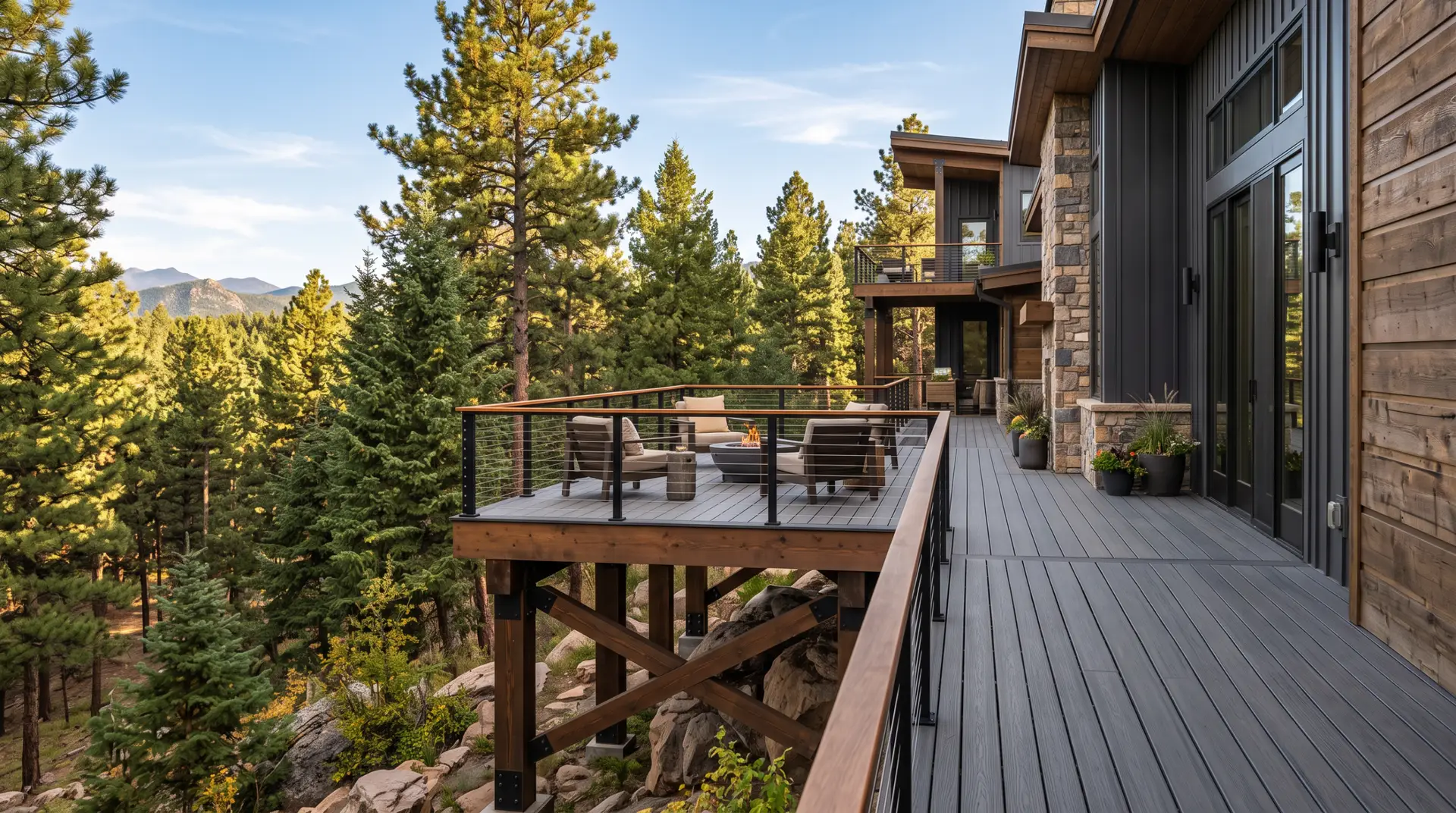
Most decking marketing focuses exclusively on the walking surface—the color, the grain pattern, and the top-side flame rating. But in an actual wildfire event, deck boards are only one component of a much larger system. Documented structural fire investigations show that decks ignite primarily through three pathways:
- Ember accumulation in board gaps: Wind-driven embers lodge in the narrow spaces between deck boards, generating localized heat against the framing underneath.
- The under-deck space: Dry leaves, pine needles, and forest debris settle beneath elevated mountain decks, right where embers drop out of turbulent winds to create sustained ground fires.
- The deck-to-house ledger connection: When an attached deck ignites, the ledger board delivers fire directly against the home’s primary structural wall.
A deck surface with an exceptional flame spread rating sitting on untreated, exposed wood framing, over a bed of dry pine needles, attached to an unhardened wood wall, is not a hardened assembly. The surface boards are only one layer. The substructure framing, the ground management beneath, and the flashing detail at the wall connection all determine whether your deck functions as a resilient system or an ignition hazard.
What the Code Addresses for Deck Structures
When reviewing deck projects, the Jefferson County Wildfire Resiliency Code addresses the fire performance of both the walking surface and the supporting substructure in designated WUI zones. The code recognizes more than one compliance path.
What applies to your specific home depends on the parcel’s designated WUI classification and how county building officials apply structural hardening standards to your particular scope of work. Because enforcement interpretations continue to be clarified by the county as projects move through review, confirming requirements before ordering materials is the only reliable way to prevent job delays or failed inspections. You can also review what the same code means for window replacement across Conifer properties.
Who to Contact: Jefferson County Permitting
Conifer is an unincorporated mountain community. It does not have a town hall, a mayor, or a municipal building desk. Homeowners who reach out to neighboring municipal offices inevitably get bounced around in bureaucratic circles.
All building permits, zoning reviews, and WUI code enforcement for Conifer go directly through Jefferson County. As part of our estimate process, 5280 Exteriors verifies your parcel’s specific WUI zone classification and confirms current county requirements before any framing or decking materials are ordered.
Mountain Conditions: Demands Beyond Wildfire
While wildfire resilience is central, Conifer’s altitude of roughly 8,000 feet introduces severe physical demands on outdoor structures year-round:
- Intense High-Elevation UV: Thinner atmosphere subjects deck surfaces and sealants to harsh ultraviolet exposure that rapidly breaks down inferior synthetic finishes.
- Extreme Temperature Cycles: Rapid swings between freezing nights and intense mountain sun cause rapid thermal expansion and contraction across materials.
- Heavy Snowpack: Sustained snow accumulation and melting ice place heavy dead loads on deck framing and test moisture barriers.
These environmental conditions represent a structural durability concern, entirely distinct from wildfire standards. Selecting rugged, dimensionally stable materials engineered for Colorado’s climate zone HZ5 ensures your deck withstands mountain weather over the long haul.
Connecting Your Deck to Your Full Exterior Envelope
Your deck does not exist in isolation. The wall where the deck attaches is governed by the same county structural hardening standards. If you are currently replacing cedar and T1-11 siding in Conifer, upgrading the adjacent wall to noncombustible fiber cement siding ensures that your deck connection does not compromise the home envelope. Coordinating these exterior scopes creates an integrated, fully protected perimeter.
Practical Guidance for Conifer Homeowners
Before moving forward with a deck replacement project in the foothills, keep these practical steps in mind:
- Confirm your WUI classification early: Verify your property’s exact status with Jefferson County before finalizing designs.
- Examine the entire substructure: Ask your contractor what materials will be used for the framing, posts, and joist protection, not just the walking boards.
- Inspect connection and ground details: Ensure there is a clear plan for flashing at the house wall and clearing debris in the under-deck area.
- Review detailed project parameters: For broader planning, research composite deck costs and material comparisons to understand how different product lines align with mountain budgets.
- Demand written ratings: Insist that the specific flame spread rating, testing standard (such as ASTM E84 or CSFM), and collection name appear clearly in writing on your contract.
- Account for mountain logistics: Steep mountain grades, switchbacks, and a shorter high-altitude build season require careful staging and scheduling.
Plan Your Mountain Deck Project
Building a resilient deck in Conifer requires clear communication, strict adherence to county codes, and precise material selection. Having a team that understands mountain building science ensures your project is completed properly from the ground up.
Contact 5280 Exteriors today to request a free estimate for your Conifer home.