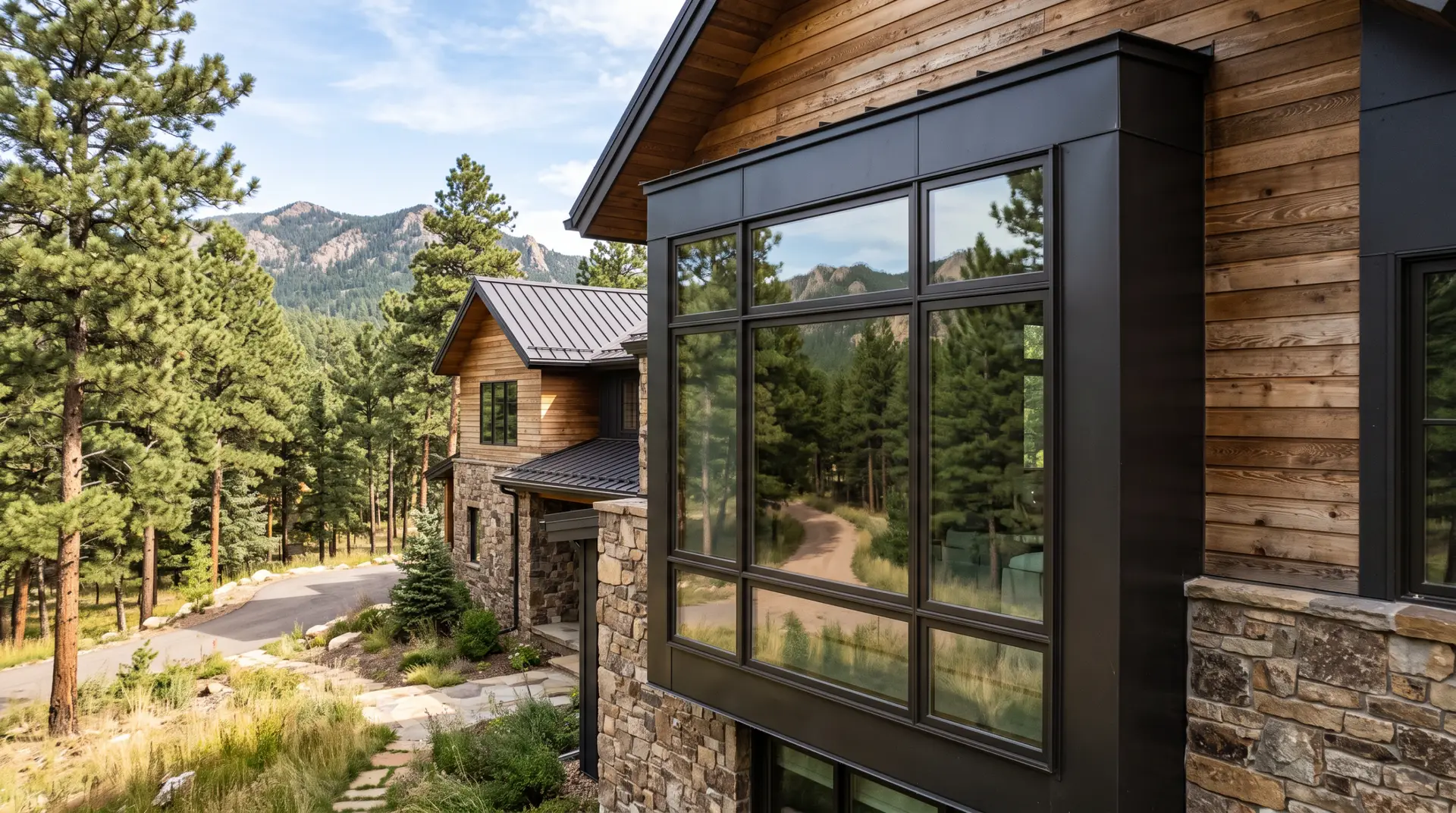
Jefferson County’s Wildfire Resiliency Code Is in Effect
If you own a home in Conifer and you have been thinking about replacing your windows, the rules changed this summer. Jefferson County’s Wildfire Resiliency Code officially took effect on July 1, 2026. If you live in an unincorporated part of the county inside the Wildland Urban Interface (WUI) Overlay District—which includes nearly all of Conifer—this code applies directly to your property.
A lot of folks assume building codes only matter when someone pulls a permit to build a brand-new house from the ground up. That is not how this code works. It covers exterior alterations and retrofits, not just new construction. Window replacement is one of the specific alterations covered under the county framework. As an exterior contractor serving Conifer, we want to walk through exactly what this means for your home before you sign a contract or order materials.
Where the Wildfire Resiliency Code Came From
This local update did not happen in a vacuum. The State of Colorado adopted a statewide Wildfire Resiliency Code effective July 1, 2025. That legislation required local jurisdictions across Colorado with designated WUI zones to adopt their own local codes by April 1, 2026, and to begin full enforcement on July 1, 2026.
Jefferson County developed and approved its own local implementation to address the specific wildfire risk across the foothills and mountain corridors. Nearby mountain jurisdictions have taken similar paths—Clear Creek County adopted comparable requirements around the same timeline. In Jefferson County, the regulations apply to new builds and covered exterior alterations, establishing structural hardening standards across different property risk levels.
What the Code Addresses for Exterior Windows and Glazing
When it comes to windows, the code focuses on how exterior glazing performs when exposed to radiant heat and wind-driven embers. The standard addresses exterior windows, window walls, glazed doors, glazed inserts within exterior doors, and skylights.
It is important to understand that the code recognizes more than one way to satisfy glazing requirements. There is no single universal product or one-size-fits-all solution that applies to every structure in the foothills. What applies to your specific home depends on your property’s designated WUI classification and how county building officials apply the requirements to your particular scope of work.
Because the local enforcement interpretations and specific compliance paths continue to be refined by county building officials as projects move through review, the critical takeaway is process: you need to confirm your property’s specific classification and the exact glazing standard with the county before anything is ordered, not after a delivery truck drops crates in your driveway.
Who to Contact: Jefferson County vs. Municipalities
One of the most common headaches mountain homeowners run into is calling the wrong building department. Conifer is an unincorporated community in Jefferson County. It is not an incorporated town or city. There is no Conifer City Hall or municipal permit desk.
If you call a nearby city or municipal building office, you will get bounced between departments and sent in circles. Everything concerning permits and WUI code compliance for Conifer properties goes directly through Jefferson County Planning and Zoning and the Jefferson County Building Safety Division.
Navigating county permitting should not be your burden. As an authorized Pella dealer and installer, 5280 Exteriors confirms your property’s WUI zone classification and verifies the applicable glazing standards with Jefferson County as part of our initial estimate process, well before placing an order.
Why Glazing Performance Matters Beyond Code Compliance
Meeting county standards is necessary for permits, but high-performance glass provides practical benefits that go well beyond passing an inspection. During a wildfire, radiant heat from nearby burning trees or adjacent structures can cause single-pane or standard annealed glass to crack and fall out long before actual flames touch the house. Once a window gives way, heat and embers enter the living space directly.
Stronger glazing assemblies hold up significantly better under sustained radiant heat exposure. Multi-pane insulated construction creates an essential thermal barrier, slowing heat transfer into the home’s interior. Investing in higher-performing Pella window replacement gives your home genuine physical resilience in a wildfire environment, making it a sound structural upgrade rather than just a compliance checkbox.
Ember Intrusion Happens at the Openings
While glass strength handles radiant heat, wind-driven embers pose an entirely separate threat. Embers do not pass through solid panes of glass; they exploit tiny gaps, unsealed trim, failing weatherstripping, and compromised rough openings around the frame.
A high-performance window will not protect a home if the perimeter installation is compromised. Proper exterior sealing, flashing integration, and tight rough-opening integration are just as critical as the glass package itself. In mountain environments, keeping embers out requires a complete, gap-free installation envelope.
Altitude and Climate: Demands Beyond Wildfire
Wildfire resilience is critical, but Conifer’s mountain climate imposes severe daily demands on your windows year-round. Sitting at roughly 8,000 feet, Conifer experiences environmental stresses that flatland metro homes rarely face:
- Intense High-Altitude UV Exposure: Thinner atmosphere at elevation allows intense ultraviolet radiation to break down inferior vinyl frames, dry out sealants, and degrade exterior finishes much faster than in the Denver basin.
- Severe Daily Temperature Swings: Mountain days can bring 50-degree temperature fluctuations within a single 24-hour cycle, causing continuous expansion and contraction across frame materials and glass seals.
- Heavy Snowpack and Wind: Winter storms bring heavy snow accumulation along sills and high-velocity mountain wind that tests the structural rigidity of every unit.
These elevation factors represent a long-term durability issue, entirely separate from wildfire codes. Choosing rugged, dimensionally stable frame materials engineered for Colorado’s climate zone HZ5 ensures your windows stay airtight and functional across decades of mountain weather.
Connecting Windows to Your Full Exterior Envelope
A window is only as resilient as the wall surrounding it. Under Jefferson County’s Wildfire Resiliency Code, exterior wall cladding is regulated alongside glazing. Siding materials must resist ember ignition and radiant heat in designated WUI zones.
Many homeowners choose to address siding and windows simultaneously. If you have been looking into replacing cedar and T1-11 siding in Conifer, upgrading to noncombustible James Hardie fiber cement siding provides a fully hardened wall assembly. Coordinating window and siding replacements ensures your flashing layers, moisture barriers, and fire-resistant materials tie together seamlessly without gaps.
Practical Guidance for Conifer Homeowners
If you are planning an exterior project in Conifer or evaluating exterior work in Evergreen and the foothills, keep these practical steps in mind:
- Confirm your WUI zone early: Verify your exact parcel classification with Jefferson County before finalizing any product selections.
- Account for lead times: Specialized glazing packages and custom high-altitude assemblies often have longer manufacturing timelines than standard off-the-shelf units. Plan your project schedule accordingly.
- Factor in mountain logistics: Steep driveways, tight mountain switchbacks, snow seasons, and staging limitations require experienced mountain installation crews.
- Get written confirmation: Always require your contractor to put the exact glazing specification in writing on the proposal, along with how they verified compliance with Jefferson County.
Schedule a Consultation for Your Mountain Home
Replacing windows in the foothills requires balancing county code requirements, wildfire resilience, and high-altitude durability. Having an experienced team handle the details ensures your home is protected and fully compliant.
Reach out to 5280 Exteriors today to request a free estimate for your Conifer property.