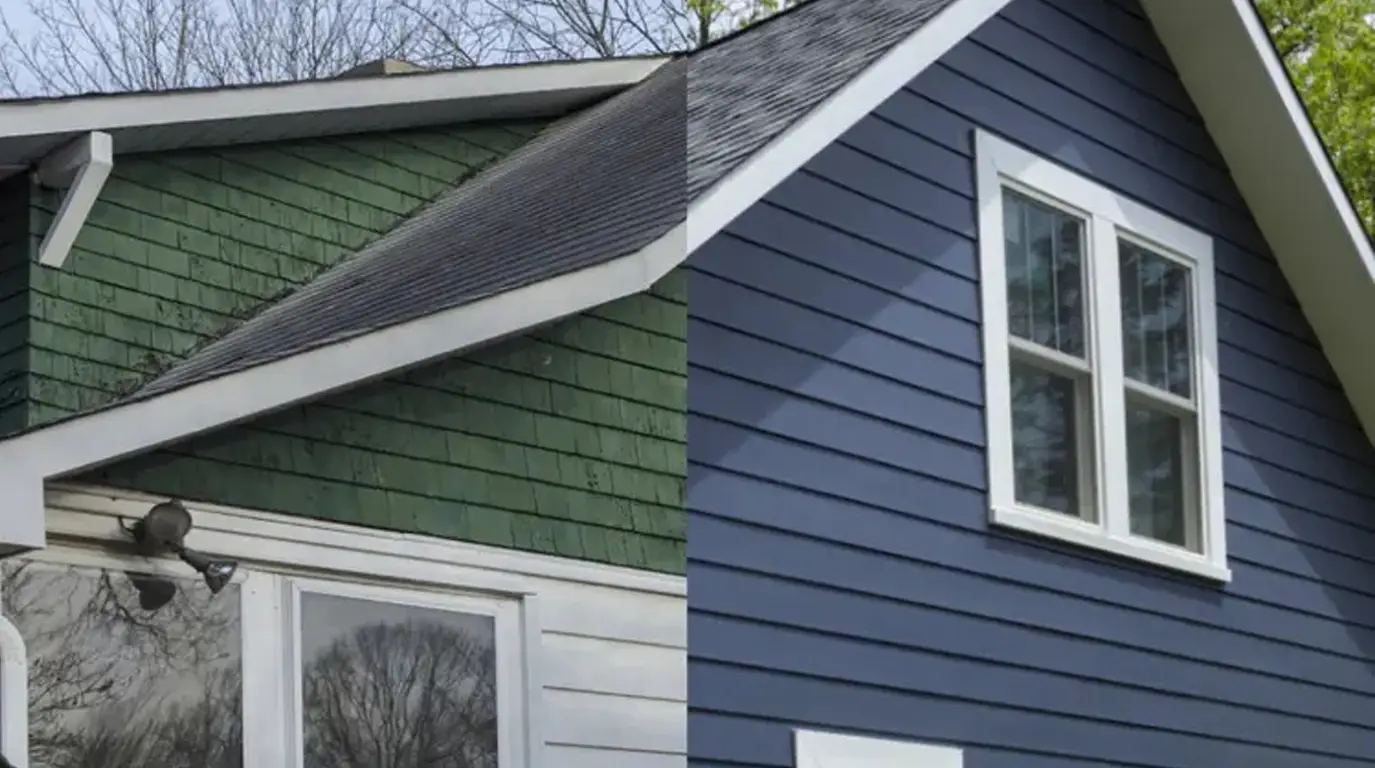
JAMES HARDIE SIDING REPLACEMENT IN CENTENNIAL, CO
If you drive through Southglenn, Cherry Knolls, or Willow Creek right now, you’ll see the same thing on street after street: siding that has reached the end of its service life, all at roughly the same moment. That isn’t a coincidence. It’s the predictable result of how Centennial was built.
5280 Exteriors is headquartered in Centennial, off South Yosemite Street. We’re a James Hardie Elite Preferred Contractor and a back-to-back Presidents Club Award winner for 2024 and 2025. This guide covers why so many Centennial homes need siding at once, how to identify what’s currently on your house, what James Hardie fiber cement actually costs here, and how to get a color scheme through your HOA without a second submission.
Why Half Your Neighborhood Needs Siding at the Same Time
Centennial didn’t incorporate until 2001, but the housing came decades earlier. Most of the city was built out between the mid-1970s and the mid-1990s, subdivision by subdivision, in tight windows of two to five years each.
That means the homes on your street were built by the same builder, in the same season, using the same materials, from the same supplier. They’ve been standing in the same sun and the same hailstorms ever since.
So when siding starts failing, it doesn’t fail one house at a time. It fails on a cohort schedule. If two or three neighbors have replaced siding in the last eighteen months, your house is on the same clock — not because anything is wrong with it specifically, but because it’s the same age.
Homeowners often tell us they were caught off guard. They shouldn’t be. This is the most predictable exterior expense in the entire Denver metro, and Centennial is right in the middle of the window.
What’s Actually on Your House Right Now
Before you shop for new siding, it helps to know what you’re removing. Four materials dominate Centennial’s housing stock, and each one fails in a recognizable way.
Hardboard siding (Masonite, LP, and similar):
Extremely common on late-1970s and 1980s Centennial homes. It’s a pressed wood-fiber product that looks like painted lap siding from the street. It fails at the bottom edges first — swelling, softening, and delaminating into layers you can peel apart with a fingernail. Once it starts, it doesn’t stop. Repainting traps the moisture rather than fixing it.
T1-11 plywood panels:
Vertical grooved sheets, usually on 1970s builds and often on gable ends or garage walls. It fails at the panel seams and around fasteners. Look for dark staining below nail heads and soft spots where two sheets meet.
Cedar lap and cedar shake:
Common on the higher-end 1980s builds around Cherry Knolls, Heritage Greens, and Palos Verdes. Cedar holds up better than hardboard but demands repainting every five to eight years in Colorado sun. When homeowners stretch that interval, the wood cups, splits, and starts taking on water at the end grain.
Early vinyl:
Mostly 1990s. Colorado UV makes vinyl chalky and brittle, and brittle vinyl doesn’t survive hail — it cracks and punches through rather than denting.
If you’re seeing any of this on your home, you’re not looking at a repair. You’re looking at a replacement that’s already overdue.
Why James Hardie Fiber Cement for a Centennial Home
Fiber cement is a composite of Portland cement, sand, and cellulose fiber. It doesn’t rot, it doesn’t feed insects, and it doesn’t burn. For a Front Range home, three properties matter most.
It survives hail. Centennial sits in one of the most active hail corridors in the United States. Fiber cement dents under severe hail rather than cracking or puncturing the way vinyl and aged hardboard do. Fewer penetrations means fewer paths for water to get behind the wall.
The finish holds. ColorPlus is a factory-applied, baked-on finish, not field paint. At Centennial’s roughly 5,800 feet, UV exposure is meaningfully more intense than at sea level, and a field-painted surface shows it within a few seasons. ColorPlus carries a 15-year limited warranty against peeling, chipping, and cracking.
We install the HZ5 line. James Hardie manufactures two regional formulations. HZ5 is engineered for freeze-thaw climates like ours. HZ10 goes to hot, humid regions. This isn’t marketing — they’re different products with different moisture and dimensional-stability characteristics, and a contractor who orders the wrong one for Colorado creates problems that surface a few winters later. We spec HZ5 on every Centennial project.
|
COMPONENT
|
TERM
|
|---|---|
|
James Hardie Product
|
30-year limited, non-prorated
|
|
ColorPlus Finish
|
15-year limited
|
|
5280 Exteriors Workmanship
|
10 years
|
Getting Your Colors Through HOA Review
This is the step that trips up more Centennial projects than any technical detail on the job.
Much of Centennial is governed by an HOA, and many of those associations have architectural review committees with written color palettes, submission deadlines, and meeting schedules that run monthly rather than on demand. A submission that misses a meeting can cost you three or four weeks of project timeline.
What tends to slow people down:
- Submitting a siding color without the trim and accent colors specified alongside it
- Choosing a color that isn’t on the approved palette and having to resubmit
- Not accounting for the review meeting calendar when scheduling installation
- Assuming a like-for-like replacement doesn’t require review — many associations require it regardless
How we handle it: we walk you through ColorPlus combinations that have historically cleared review in Centennial neighborhoods, provide physical samples and photo renderings for the submission packet, and build the review window into the project schedule rather than discovering it later. You can also run combinations yourself in our visualizer before you ever submit.
Popular combinations in Centennial lean toward warmer neutrals — Khaki Brown with Arctic White trim, Monterey Taupe with darker accents, Pearl Gray with Iron Gray details. These read well against the brick accents common on 1980s builds here.
Permits and Inspections
Siding replacement in Centennial requires a permit through the City of Centennial. We pull it, schedule inspections, and manage the approvals as part of the project. You don’t need to interact with the process.
Worth knowing: if your home has any structural repair discovered during teardown, that can change the inspection sequence. We flag it when we find it rather than working around it.
The Process, Start to Finish
- Free estimate at your home. We assess current siding condition, check substrate where we can, discuss materials, and provide a written estimate — usually within 24 to 48 hours.
- Color selection and HOA packet. We help you land on a combination and assemble what your association needs.
- Permitting. We submit and manage it.
- Teardown and substrate repair. Old siding comes off, sheathing gets inspected, and anything that needs repair gets repaired before we build back.
- Weather barrier and flashing. HardieWrap, flashing at every penetration, and a proper drainage plane. This is the invisible work that determines whether the wall lasts.
- Installation. HZ5 fiber cement, blind-nailed to James Hardie specification. Not stapled.
- Final walkthrough. We’re not done until you say so, and you get complete warranty documentation.
Most full-home Centennial projects run one to two weeks on site.
Why Homeowners Here Choose 5280 Exteriors
We’re based in Centennial. Our office is at 7000 S Yosemite St. This isn’t a service area we drive out to — it’s where we work from.
James Hardie Elite Preferred Contractor. The top tier of James Hardie’s contractor program, which requires ongoing certification and installation to manufacturer specification.
Back-to-back Presidents Club Awards, 2024 and 2025. A national recognition given to a small group of contractors for installation quality and customer satisfaction.
One contractor for the whole exterior. We also handle windows, GAF roofing, and TimberTech decking. If you’re doing more than one, bundling means a single permit process, a single crew mobilization, and one disruption to your life instead of three.
20 years of Front Range installations, with a 10-year workmanship warranty behind every one.
Centennial Siding Questions
My neighbors just replaced their siding. Does that mean mine needs it?
Probably, eventually. Homes in a Centennial subdivision were typically built within a few years of each other with identical materials. If the same product is failing next door, yours is on the same timeline. It doesn’t mean this month — but it does mean you should have it looked at rather than waiting for a leak.
Can James Hardie go over my existing hardboard siding?
No, and you wouldn’t want it to. Hardboard that’s failing is holding moisture, and burying it traps that moisture against your sheathing. We remove the old material completely, inspect what’s underneath, and repair before installing.
What if you find rot when the old siding comes off?
It happens regularly on homes where hardboard has been failing for a few seasons. We document it, show you, and repair it. We try hard to identify the likelihood during the estimate so the number you’re given reflects reality rather than a best case.
<p”>Do I need HOA approval for a like-for-like color?
Usually yes. Most Centennial associations require architectural review for any exterior material change, even when the color is close to what’s already there. Check your covenants, and build the review window into your timeline.
How does fiber cement handle hail?
Better than anything else in the residential category. Severe hail can dent it, but it resists the cracking and puncturing that lets water into the wall. That distinction matters more than cosmetic appearance.
What’s the difference between HZ5 and HZ10?
They’re regional formulations. HZ5 is built for freeze-thaw climates like Colorado’s. HZ10 is built for hot, humid regions. We install HZ5 on every project here.
Get a Free Centennial Siding Estimate
If your siding is showing its age — swelling at the bottom edges, splitting, chalking, or just visibly tired next to the houses that have already been done — we’ll come look at it and tell you honestly where it stands.
Call (720) 707-6964 or request a free estimate online.
Learn more about our full range of exterior services in Centennial.